
If you’ve been comparing international movers, you’ve probably seen the phrase “IAM certified” on a company’s homepage — usually next to a badge or logo that looks vaguely official. It is official. The International Association of Movers, or IAM, is the closest thing the moving industry has to a global watchdog. Getting certified through it isn’t a rubber stamp you buy for a fee. It’s a credential that tells you something real about who’s about to pack up your entire life and ship it across an ocean.
Let’s get into what IAM actually is, how a company earns the right to call itself IAM certified, and why that badge should carry real weight when you’re deciding who touches your belongings.
What Is the International Association of Movers?
IAM is a nonprofit trade association — not a government body, not a certification mill. It’s made up of moving and forwarding companies from more than 170 countries. IAM was formed back in 1962. It started under a different name, the Household Goods Forwarders Association of America, and rebranded to IAM in 2009. Since then, it’s grown into something closer to the connective tissue of global moving.
Think of it as the network that lets a mover in Colombo coordinate seamlessly with a destination agent in Melbourne or Dubai. That coordination runs on shared standards, shared vetting, and a shared reputation worth protecting.
The association covers a lot of ground: household goods relocation, government and military moves, pet relocation, vehicle shipping, and high-value logistics. But for the average person moving overseas, what matters is simpler. IAM membership signals that a company has been through a screening process most fly-by-night movers never bother with.
So What Does “IAM Certified” Actually Mean?
Here’s where people get confused, and honestly, it’s a fair mix-up. Not every company that mentions IAM is equally credentialed. There’s a gap between simply being an IAM member and holding one of the association’s real certifications. Programs like the FAIM (FIDI Accredited International Mover) standard, or IAM’s own quality and ethics programs, sit a level above basic membership.
To be listed as a genuine IAM member in good standing, a company has to:
- Submit to a review of its financial stability — no shell companies, no fly-by-night operators
- Demonstrate operational history and industry references
- Agree to IAM’s code of ethics, which covers everything from pricing transparency to claims handling
- Maintain ongoing compliance, because membership isn’t a one-time checkbox — it gets reviewed
That last point is the one people miss. A mover doesn’t get IAM certified once and coast on it forever. The association keeps tabs. Companies that rack up unresolved complaints or ethics violations can — and do — lose their standing.
Why an IAM Certified Moving Company Is Worth Paying Attention To
Moving your household across borders is not a low-stakes transaction. You’re trusting a stranger with furniture that took years to collect and documents you can’t replace. Often, there’s a job relocation or family relocation timeline riding on it too, and that’s already stressful enough. So why should the IAM badge matter to you specifically?
It filters out the operators who disappear. International moving scams are more common than people expect. A “company” takes a deposit, quotes a low number, then either vanishes or holds your goods hostage for a bigger payout mid-shipment. An IAM certified mover has a business address, an ethics agreement, and a reputation on the line. That alone rules out most of the worst actors.
It means someone else already checked their paperwork. You’re not a customs broker. You probably don’t know offhand whether a mover carries proper cargo insurance or holds valid freight forwarding licenses in every country it works in. IAM’s vetting process does a chunk of that homework before you ever get a quote.
It plugs the company into a global network you actually benefit from. This is the part people underestimate. IAM connects thousands of movers worldwide. That means an IAM certified company in Sri Lanka or the UAE likely has working relationships — real ones, not just a directory listing — with destination agents wherever you’re headed. That network is what keeps your shipment from getting stuck in some bureaucratic no man’s land at a foreign port.
It gives you somewhere to go if things go wrong. Members agree to a dispute resolution framework. If a mover with no affiliations mishandles your move, your options are limited to a bad review and maybe small claims court. With an IAM member, there’s an actual body they’re accountable to.
How to Check the IAM Directory Before You Book
This is the step most people skip, and it takes about ninety seconds. IAM maintains a public IAM Directory where you can search for a company by name and confirm active membership. Don’t just trust the badge on a website. Badges can be copied, screenshots can be old, and memberships can lapse. Pull up the directory, search the company, and confirm they’re current.
While you’re at it, it’s worth cross-referencing a couple of other things:
- Confirm the membership is active, not expired or historical
- Check whether the certification level applies to household goods moves specifically, since some members focus on freight or government contracts instead
- Look at how long they’ve held the certification — a company that’s maintained good standing for a decade tells a different story than one that joined six months ago
Reading IAM Reviews the Right Way
IAM reviews aren’t quite the same animal as your typical Google or Trustpilot review. IAM membership involves industry peer input and ethics complaints, so patterns tend to surface there that wouldn’t show up in a five-star review farm. If a company has a history of unresolved grievances filed through IAM’s channels, that’s a far more reliable red flag than a scattering of one-star reviews from anonymous accounts.
That said, don’t treat IAM certification as the only signal you need. Pair it with independent customer reviews and ask for references from recent international moves. If a company can walk you through their actual process — customs documentation, insurance coverage, delivery windows — without dodging specifics, that’s a good sign layered on top of the certification itself.
IAM Conference 2026 and Why Industry Involvement Matters
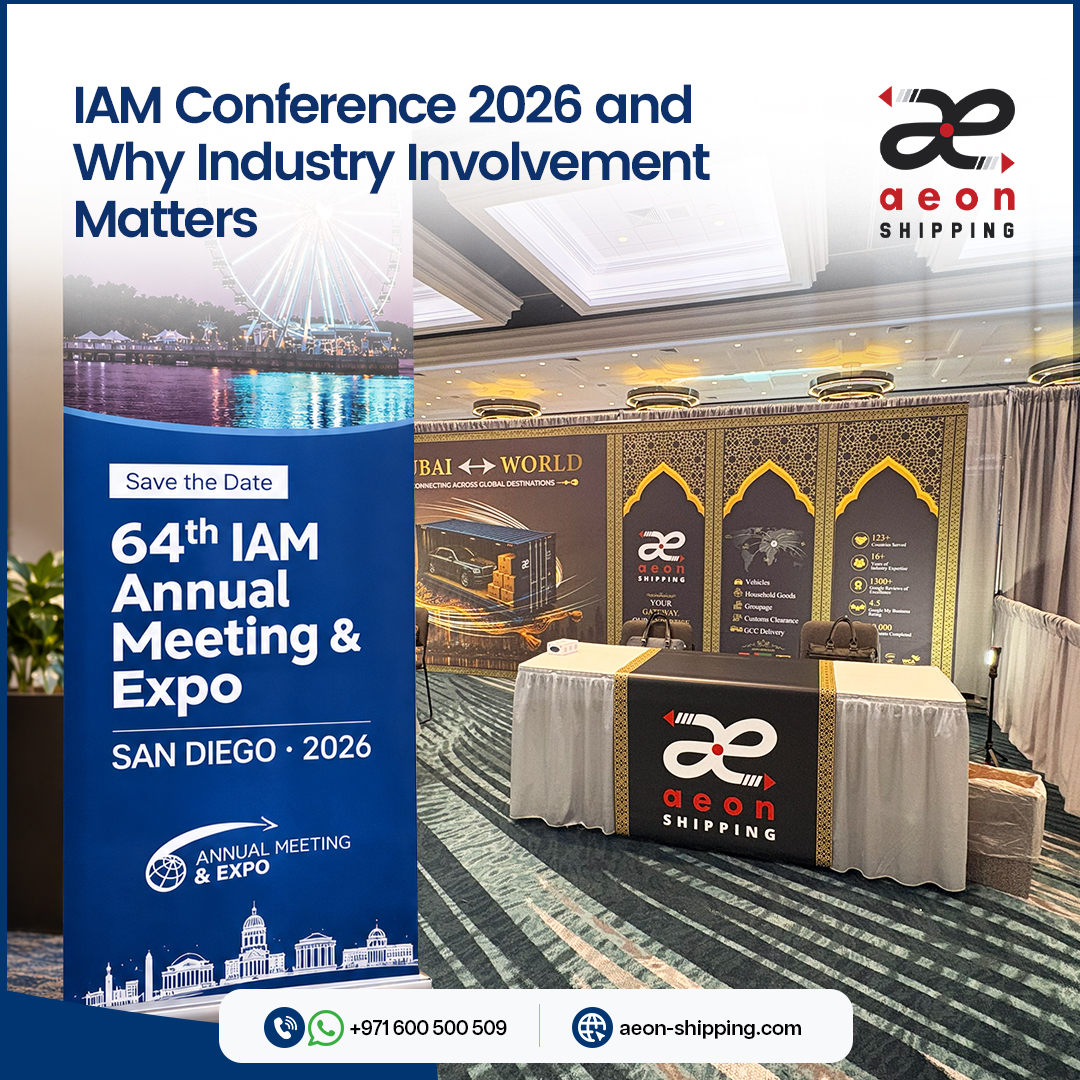
Every year, IAM holds its annual conference. The IAM Conference 2026 gathering is where a lot of the industry’s actual relationship-building happens. Movers, forwarders, insurers, and destination agents all end up in one room, hashing out the partnerships that eventually become the network your shipment relies on. A company that shows up to these events year after year isn’t doing it for fun. They’re maintaining the relationships that make international logistics actually function on the ground, not just on paper.
If you’re vetting a mover, it’s fair to ask whether they participate in industry events like this. It’s a small question, but the answer tells you whether a company treats its IAM membership as an active relationship or a logo they slapped on their site once and forgot about.
What This Looks Like in Practice
At Aeon Shipping, IAM certification isn’t a badge we display and hope nobody checks. It’s baked into how we actually run international household goods moves — from route planning across more than 135 countries to coordinating with vetted destination agents on the other end. Over 20,000 shipments and 15-plus years, that network has kept delivery windows realistic and customs paperwork from turning into a nightmare. It’s built through exactly the kind of industry relationships IAM exists to formalise.
That’s really the point of the certification. It’s not decoration. It’s the difference between a mover who’s part of a global, accountable system and one who’s improvising.
Common Misconceptions About IAM Certification
A few myths keep circulating, and they’re worth clearing up before you make a decision based on bad information.
“Any company can just say they’re IAM certified.” Technically, someone could type that on a website, sure. But it’s easy to catch. The directory is public. If a claim doesn’t match the record, that’s not a clerical error. That’s a company you should walk away from.
“IAM certification means the move will be flawless.” No certification guarantees a perfect move. International logistics involves customs delays, weather, and port congestion — things no association can control. What IAM certification does is stack the odds in your favour. It also gives you recourse if something goes wrong because of the mover’s own conduct, not external circumstances.
“All IAM members are equally established.” Not quite. Membership tiers and certification levels vary, and a company that joined recently hasn’t built the same track record as one that’s held ethics-compliant standing for a decade. The directory usually shows how long a company has been listed — it’s worth a glance.
“IAM only certifies big international carriers.” Actually, a good number of IAM members are mid-sized regional movers who partner with larger networks for the international legs. Size isn’t the qualifier — compliance and reputation are.
What Happens If You Skip This Step
It’s tempting to just go with whoever quotes the lowest price and skip the verification altogether. Most moves do go fine, even with unverified companies. But the ones that go badly, go badly. Deposits that vanish. Goods held in a warehouse somewhere pending an unexpected “storage fee.” Delivery windows that stretch from six weeks to six months with no real explanation.
None of that is hypothetical. It’s a documented pattern in the industry, which is precisely why IAM exists in the first place. A five-minute directory check is a small price for the peace of mind that comes with it. You’re not gambling your furniture, your paperwork, and your moving budget on a company nobody’s vetted.
Frequently Asked Questions
Is IAM the same as FIDI? No, though they’re related. FIDI (Fédération Internationale des Déménageurs Internationaux) commonly known as FIDI Global Alliance is a separate body with its own FAIM (FIDI Accredited International Mover) certification. Some movers hold both. IAM is broader and US-headquartered, while FIDI is more Europe-centric. A company can be legitimate holding either, or both.
Does IAM certification cost the mover money? Yes — membership involves dues, which is part of why not every mover bothers. But dues alone don’t grant certification; the vetting process is what actually matters.
Can a company lose its IAM certification? Yes. Ethics violations, unresolved complaints, or failure to maintain standards can result in suspension or removal from the directory.
Should I only use IAM certified movers? It’s not the only factor. But it’s one of the fastest ways to narrow a shortlist down to companies worth getting quotes from. Combine it with reviews, references, and a direct conversation about how they handle customs and insurance.
How do I verify a company is really IAM certified? Search the official IAM Directory directly rather than relying on a badge or claim on the company’s own website.
The Bottom Line
An IAM badge on a moving company’s website isn’t just marketing — or at least, it shouldn’t be treated that way. It stands for a vetting process, an ethics agreement, and access to a global network. That network is what actually gets your belongings from one country to another without a mess of missed handoffs and customs confusion. Check the directory, read past the badge, and treat the certification as one solid data point among several. Do that before you hand over your life’s belongings to anyone crossing a border with them.

