

Shipping household goods out of the UAE isn’t like posting a parcel. It’s boxes, furniture, and years of accumulated life, all riding on decisions you make weeks before the truck even shows up. Maybe you’re heading home after a contract ends. Maybe you’re relocating onward to a new posting entirely. Either way, getting this right saves you money, saves you stress, and spares you the sinking feeling of a shipment stuck in a bonded warehouse somewhere you can’t reach.
This guide walks UAE-based expats through the whole process — choosing between air and sea freight, the paperwork customs officers actually check, and the mistakes that turn a simple move into a six-week headache.
How Much Can You Bring Duty-Free?
This is the question most UAE expats want answered before anything else: will customs charge you to bring your own belongings into your new country? It comes down to one distinction — used versus new.
Most countries exempt used personal effects and household goods from import duty when you’re relocating. But there are conditions attached, and they trip people up more often than you’d think:
- Valid residency required. You generally need residency, or returning-resident status, in the destination country — exemptions are almost always tied to proving you’re actually moving there, not importing goods speculatively.
- Items must be genuinely used. A sofa you’ve owned for two years qualifies without question. A brand-new television still sealed in its factory box doesn’t — customs treats that as a commercial import and taxes it accordingly, typically around 5% of declared value, sometimes with VAT stacked on top.
- No commercial quantities. Customs officers are checking whether your shipment looks like a household move or a business bringing in stock. Ten identical unopened kitchen appliances raises a flag; one used set doesn’t.
- Inventory has to be accurate. A vague or incomplete declaration is one of the fastest ways to lose an exemption by default — if customs can’t match your goods to your paperwork, they’ll often just apply the standard rate.
Here’s the one piece of advice that saves more UAE expats than anything else in this guide: unbox anything you bought newly specifically for the move before it goes in the container. A factory-sealed box practically invites inspection and tax, even when the item is genuinely for personal use. Unwrapped, sitting alongside the rest of your used furniture, that same item is usually just treated as part of your household effects.
Worth flagging too — exemption rules aren’t identical everywhere. Some countries apply value caps or category-specific limits even to used goods. Confirm the threshold for wherever you’re headed before you lock in your inventory; your mover should be able to tell you exactly what applies.
Air Freight vs. Sea Freight: Which One Should You Choose?
This is the first real decision, and it shapes your budget, your timeline, and how much you can actually take with you.
Air Freight
Air freight gets your goods there in days, not weeks. That makes it the right call when your new home is ready immediately, or when you’re only shipping a smaller volume — a few boxes, essential documents, electronics you don’t want sitting in a container for a month. Figure on roughly 5 to 10 days depending on destination and how customs processes it at the other end. The catch is cost: air freight is priced by weight, so a full load of furniture gets expensive fast.
Sea Freight
Most full-household relocations end up on the water, because it’s dramatically cheaper for volume. Within sea freight you’re choosing between Full Container Load (FCL) and Less than Container Load (LCL).
FCL and LCL cover most household moves:
- Full Container Load (FCL): You book an entire container — usually a 20ft, which suits a two- to three-bedroom home, or a 40ft for a four- to five-bedroom home — exclusively for your own goods. Nothing else touches your shipment in transit, which cuts handling risk considerably.
- Less than Container Load (LCL): Your goods share space with other shipments heading to the same destination, so you only pay for the volume you actually use. It’s the more budget-friendly option for smaller households, though it does mean more handling at consolidation points and slightly longer transit windows.
Transit times swing wildly by route. A container leaving Jebel Ali for a nearby GCC or South Asian port might clear in two to three weeks. One bound for the Americas or parts of Europe can take four to twelve weeks once you factor in customs at both ends. If your move date has any flexibility at all, sea freight is almost always the smarter financial call. If it doesn’t, air freight — or a hybrid, essentials by air and the rest by sea — is worth paying for.
What Shipping Household Goods Actually Costs
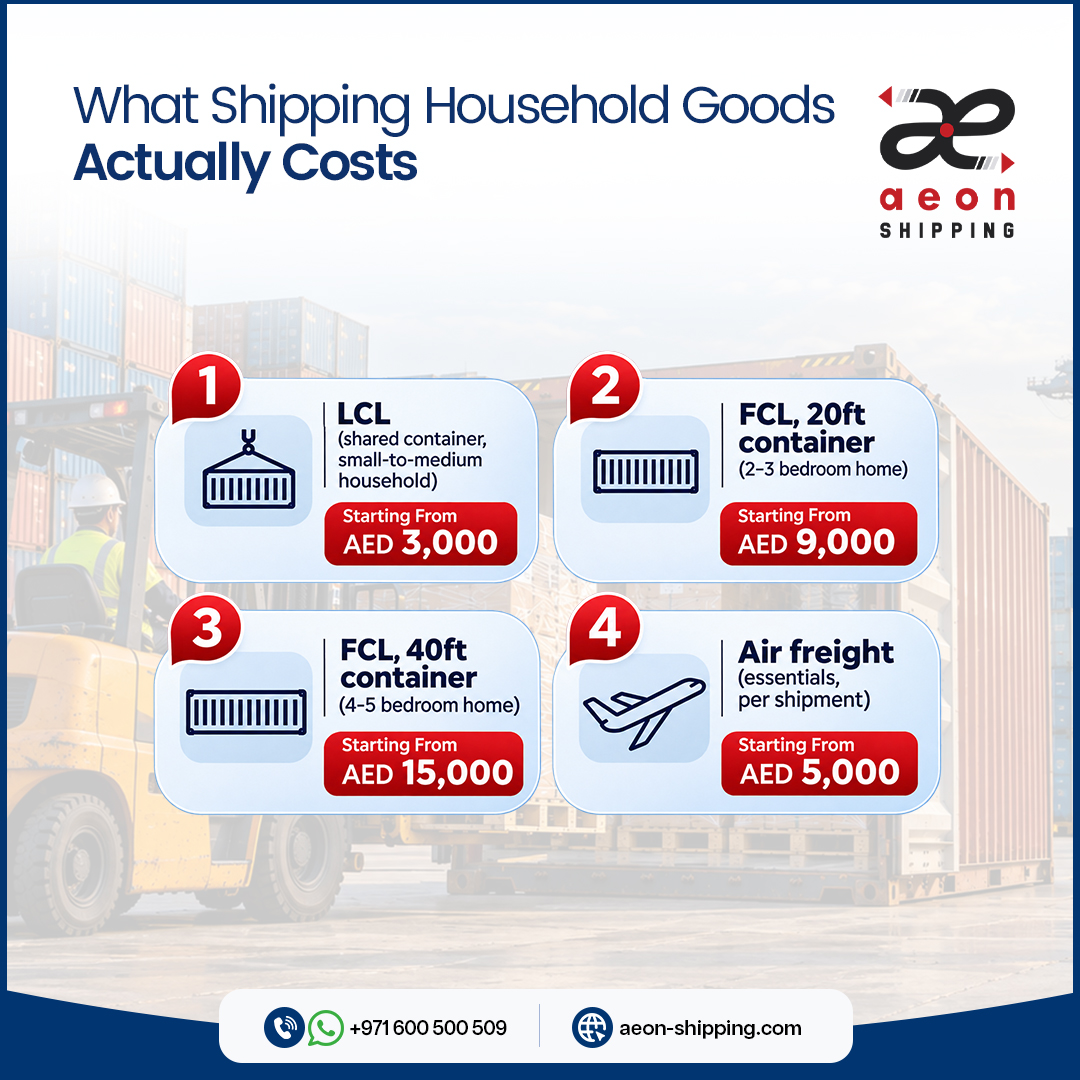
Pricing depends on distance, volume, container type, and how much service you’re buying — port-to-port only, or full door-to-door with packing included. As a general starting-price guide for UAE-origin shipments in 2027:
| Shipping Method | Starting From |
| LCL (shared container, small-to-medium household) | AED 3,000 |
| FCL, 20ft container (2–3 bedroom home) | AED 9,000 |
| FCL, 40ft container (4–5 bedroom home) | AED 15,000 |
| Air freight (essentials, per shipment) | AED 5,000 |
Those figures cover freight itself — the ocean or air cost, port to port. Door-to-door service, professional packing, customs brokerage, destination handling, and insurance are usually quoted separately, and they add up fast. Push for an itemised breakdown rather than accepting one bundled number, so you actually know what you’re paying for.
A handful of factors move the price more than people expect:
- Destination customs fees. These can outweigh the freight cost itself on some routes — ask your mover what to expect on arrival, not just at origin.
- Volume, not just weight. Sea freight is charged largely by cubic metre, so bulky, low-density items like sofas and mattresses eat up chargeable volume even though they’re relatively light.
- Peak season timing. Rates fluctuate with global demand — shipping during a quieter window can genuinely lower your quote.
- Access at both ends. A villa with ground-floor loading is a very different job from a 20th-floor apartment with one slow service lift, and that shows up in labour costs.
Shipping Household Goods from Dubai: Port and Route Considerations
Where you’re shipping from within the UAE affects which port handles your cargo, and how smoothly things move at origin. Most Dubai-based expats ship through Jebel Ali Port — one of the busiest container ports on earth. That’s an advantage, since it means frequent sailings and well-worn routes to almost anywhere. It also means booking early during peak season actually matters, because slots fill up.
Shipping household goods from Dubai versus Abu Dhabi or Sharjah follows a broadly similar process, though the port logistics differ. Abu Dhabi shipments typically route through Khalifa Port, Sharjah through Sharjah Port or Hamriyah. Ask your mover which port your shipment will actually use — it affects the collection schedule and, on some routes, the transit time, too.
One detail worth knowing about Dubai’s mixed free zone and mainland setup: if you’re shipping from a free zone residence or a company-sponsored villa, check whether that changes the export paperwork required. Customs treats free zone origins a little differently from standard mainland exports, and it’s better to confirm that early than find out the week your packers arrive.
Documentation for Shipping Household Goods Internationally
Incomplete paperwork is the single biggest cause of shipment delays, full stop. For most international moves out of the UAE, you’ll need:
- Passport and visa copies — both your current UAE documentation and, where applicable, proof of your destination-country visa or residency status.
- A detailed, itemised packing inventory — every box, its contents, and an estimated value. Customs on both ends lean on this document heavily, and a vague or missing one is one of the fastest routes to a full physical inspection.
- Bill of Lading (sea) or Air Waybill (air) — this is your contract of carriage and your proof of ownership for the cargo.
- Original UAE labour or tenancy documents, in some cases, to prove your period of residence — this ties directly into the duty-free eligibility covered earlier, so keep these with the rest of your paperwork.
- Permits for specific categories — electronics, plants, alcohol, high-value art or antiques often need separate permits depending on where you’re headed.
Since the used-versus-new distinction from earlier is what actually determines whether your shipment clears duty-free, make sure your inventory reflects it accurately. It’s the one document customs relies on most.
Choosing a Shipping Company: What Actually Matters
Every mover’s website promises a stress-free move. Here’s what actually separates the reliable ones from the rest:
- Track record on your specific route. A company that’s genuinely worked your destination corridor will know the quirks — which port clears fastest, which documents that country’s customs office is fussy about, what the realistic transit time looks like next to the marketing-page estimate.
- Transparent, itemized quotes. A single lump-sum figure without a breakdown of freight, packing, insurance, brokerage, and destination handling is usually a sign that extra charges are coming later, not that the price is simple.
- Insurance options, clearly explained. Basic carrier liability rarely reflects what your belongings would actually cost to replace — all-risk marine insurance, priced as a percentage of your declared value, is the only real protection against loss or damage in transit. Ask what’s excluded before you ask what’s covered.
- Reviews from the right people. Look for feedback from expats who shipped the same route you’re planning — a mover that’s excellent for GCC-to-Europe moves isn’t necessarily the right fit for a GCC-to-Africa shipment.
- Responsiveness before you’ve even paid a deposit. How a company handles your questions during quoting is a fair preview of how they’ll handle a delay or a customs query once your goods are already at sea.
Why UAE Expats Choose Aeon Shipping
Aeon Shipping has been moving households out of the UAE for more than 15 years. In that time we’ve handled over 20,000 shipments to more than 135 countries — straightforward regional moves alongside complex, multi-leg relocations that needed real problem-solving to get right.
What that experience actually means for you:
- A 98% on-time delivery record. Timelines matter when you’re planning an arrival around a new job, a school term, or the end of a lease.
- Door-to-door service, not just port-to-port freight. We handle packing, documentation, customs clearance at both ends, and final delivery, so you’re not coordinating handoffs between three separate companies.
- Route-specific expertise. Fifteen years across 135+ countries means we’ve already dealt with the customs quirks, permit requirements, and seasonal bottlenecks on most of the routes UAE expats actually ship — Europe, the GCC, the Indian subcontinent, North America, Australia, and beyond.
- A track record backed by the people who’ve used it. Over 1,000 Google reviews and a 4.5-star rating, mostly from people who were exactly where you are now — packing up a life in the UAE and trusting someone else to get it to the other side in one piece.
If you’re comparing quotes from a few movers, ask each one the same questions you’d ask us. What’s included in the quote. Who handles customs on both ends. What happens if something goes wrong in transit? The answers tend to sort out pretty quickly who’s actually done this at scale and who’s guessing.
Packing Tips That Protect Your Belongings — and Your Wallet
How you pack affects both the safety of your goods and how much you end up paying, since sea freight is charged by volume.
- Downsize before you pack. Every item you don’t ship is money saved on freight and one less thing to unpack at the other end.
- Use uniform, appropriately sized boxes. Dense, heavy items like books belong in smaller boxes, while bulky, light items like linens can go in larger ones — oversized boxes with wasted space just cost you chargeable volume.
- Wrap fragile and electronic items individually. For genuinely high-value pieces — art, antiques, instruments — ask about custom crating instead of standard boxes.
- Label every box clearly, with contents and destination room both. It speeds up inspection if your shipment gets flagged, and makes unpacking far less chaotic.
- Keep your master inventory as you pack, not after. Trying to reconstruct a full list once everything’s sealed is exactly where people lose track of what’s in which box — and that gap is what invites extra scrutiny at customs.
- Set aside a “first week” box or suitcase. Bedding, basic kitchen items, chargers, key documents — so your first few nights don’t depend on your sea shipment showing up on schedule.
Avoiding Delays: What Trips Up Most Shipments
Even well-planned moves hit snags. A few causes come up again and again:
- Mismatched inventory and contents. If customs opens a box and the contents don’t match what’s declared, you’re looking at a hold — sometimes a long one — while it gets sorted out.
- Missing destination-country permits. Certain electronics, plants, food items, or restricted goods need permits arranged before the shipment even leaves the UAE. Confirm what applies to your destination well before departure, not after the container’s already sailed.
- Holiday-season clearance delays. Customs offices slow down around major public holidays on both ends, so if your move overlaps with one, build in an extra buffer.
- No plan for the arrival gap. Even a well-run sea shipment can take weeks — have interim housing, a small air shipment, or temporary storage lined up so a normal transit delay doesn’t turn into a housing crisis.
A Realistic Timeline for Shipping Household Goods Overseas
| Stage | Typical Duration |
| Survey, quote, and booking | 3–7 days |
| Packing | 1–3 days (household dependent) |
| Documentation and customs prep | Runs parallel to packing |
| Sea freight transit | 2–8 weeks (route dependent) |
| Air freight transit | 5–10 days |
| Destination customs clearance | 3–10 days |
| Final delivery and unpacking | 1–2 days |
Door-to-door, a full household sea shipment from the UAE typically lands somewhere between four and ten weeks, start to finish. Plan around that range rather than the best-case number, and a normal delay stops feeling like a crisis.
Final Thoughts
Shipping household goods internationally from the UAE really comes down to three decisions: the right freight method for your timeline and budget, getting your documentation right the first time, and picking a mover who’s actually handled your specific route before. Get those three right and everything else — packing, customs, delivery — tends to fall into place with a lot less friction than most expats expect going in.
Aeon Shipping has spent over 15 years moving households out of the UAE to more than 135 countries, with a 98% on-time delivery record behind it. If you’re planning a move and want a clear, itemised quote before committing to anything, our team can walk you through exactly what your route, volume, and timeline will involve.
Frequently Asked Questions
What’s the most cost-effective way to ship household goods from the UAE? Sea freight — specifically LCL if you’re not shipping a full household’s worth of belongings. It takes longer than air, but it’s significantly cheaper for the volume.
How long does shipping household goods from Dubai take? Air freight usually runs 5–10 days. Sea freight ranges from around two weeks on shorter regional routes to 8–12 weeks on longer intercontinental ones, once you include destination customs clearance.
Do I need a residence visa to import household goods duty-free at my destination? In most countries, yes — duty exemptions on used personal effects are typically tied to proof of residency or returning-resident status. Rules vary a fair amount by country, so confirm the specifics for your destination before you ship.
Is insurance really necessary for an international household move? It’s not legally required, but it’s worth having. Basic carrier liability rarely reflects what your belongings would actually cost to replace — all-risk marine insurance is the only real protection against loss or damage in transit.
Can I ship a mix of used and newly bought items in the same shipment? Yes, but keep new items out of their retail packaging and declare them accurately on your inventory. Plenty of countries apply duty to anything that looks factory-new or still sealed, even inside an otherwise used household shipment.

