
Shipping household goods to France from Dubai is one of those things nobody really warns you about. You make the decision, you hand in your notice, you start telling people you’re moving to France — and then somewhere around week three of planning, the consulate appointments and customs declarations and French-language inventory forms show up, and suddenly the whole thing feels very different from how it looked on paper.
Maybe your company moved you. Maybe you finally stopped talking about that Marseille apartment and actually bought it. Maybe Monaco came out of nowhere — an offer that didn’t make sense to refuse, a lifestyle that was hard to argue with. Doesn’t matter how you got here. The situation’s the same either way: a Dubai apartment full of stuff you’ve built up over the years, and a new place in France with nothing in it yet.
The good news is that people do this all the time. Not always smoothly, not always without stress — but they do it. Their things get packed, they clear customs on both ends, and eventually, the furniture arrives, and the new place starts feeling like home. Yours will too.
Sea Freight: The Default Choice
At some point, you’ll check air freight prices. Most people do. And then you’ll see the number, do a quick mental calculation, and go back to sea freight without a second thought. For a full household move, there’s really no debate — everything leaves from Jebel Ali, and it goes by sea.
France takes roughly 20 to 35 days from Dubai, though that’s not a guarantee. Routing matters, destination port matters, and your shipping company’s schedule matters. Le Havre is where most Paris-bound containers land — it’s the big northern port, handles massive traffic volumes, and the road connection to the capital is straightforward from there. Heading south? Marseille is the natural entry point for the Gulf route, and Fos-sur-Mer, right next to it, picks up a lot of the container overflow.
Direct sailings will get your stuff there quicker, but they’ll cost you more. Shared or multi-stop routes trim the bill but stretch the timeline — sometimes by a week or two, sometimes more. Neither option is objectively better. It really just comes down to your move date and whether saving money or saving time matters more right now.
The Tax Exemption France Offers and How to Qualify
France, like most EU countries, allows you to import your used personal effects without paying customs duties or VAT — provided you meet the conditions. The VAT rate in France is 20%, so getting this right saves you real money.
To qualify, you need to have lived outside the EU for at least twelve consecutive months and be establishing your primary residence in France. You’ll also need to prove that the items you’re shipping were in your possession and personal use before your move — not purchased specifically to import.
The attestation de changement de résidence is the document that unlocks this exemption. It’s essentially a declaration that you’re moving your primary residence to France. You’ll apply through the French consulate in Dubai, and processing times vary. Don’t leave this until three weeks before your shipping date — give yourself at least two months.
The Six-Month Rule on Your Belongings
France doesn’t extend the duty-free exemption to brand-new items. Everything you’re shipping needs to have been owned and used for at least six months before your move date.
Customs officers are not naive. New furniture still in its packaging, electronics sealed in original boxes, items that clearly haven’t been used — these get flagged. If you bought a new couch three months ago in Dubai, be prepared for questions. If you bought it the week before packing, be prepared to pay tax on it.
What helps enormously: photographs of your belongings in your Dubai home, timestamped, showing they were part of your actual living space. Think TV mounted on the wall, kitchen appliances on the counter, furniture with cushions worn in from real use. These photos aren’t just for insurance — they’re evidence of genuine prior ownership if customs ever question anything.
Keep receipts for anything expensive. “I’ve had this for ages” is not documentation.
Documents You Cannot Afford to Get Wrong
French customs will hold your container if the paperwork isn’t complete. And while it’s sitting there, you’re paying storage fees. Days turn into weeks, and it adds up fast.
The Documents You Need
- Attestation de changement de résidence: This is your exemption certificate. Without it, everything gets treated as a commercial import.
- A detailed inventory in French: Avoid writing “living room furniture.” List each individual item — a sofa, two armchairs, one coffee table. Write the model numbers for electronics along with estimated values in euros. French customs like things to be specific. If the container contents and the list don’t match, you will be in trouble.
- Proof of your previous address in Dubai: Utility bills, Emirates ID, and tenancy contract. They need evidence that you lived there for the required period.
- Proof of your new address in France: Or if it is in process, then proof of that.
- Copies of your passport: Containing the entry date into France.
Aeon-Shipping knows what each port expects, and they know the language of the forms. They will handle everything so that you are relieved.
Choosing Between a Full Container and Shared Space
FCL (Full Container Load)
You rent the whole container — either 20-foot or 40-foot. Better for larger homes, faster because it’s just your shipment, and transit time is more predictable. A 20-foot container costs around 30,000 to 35,000 AED. A 40-foot container costs around 40,000 to 45,000 AED, depending on the season and route.
LCL (Less than Container Load)
Your goods share space with other people’s shipments. This is good for studio apartments or partial household moves. You pay per cubic metre, which will typically cost between 2,500 and 4,000 AED per CBM. The downside is that the waiting time for the container to fill will add more weeks.
Air Freight
Fast — usually five to ten days — but expensive. Around 18 to 25 AED per kilogram. Most people use this only for the absolute essentials they need immediately: clothes, work equipment, and medication.
Shipping Methods at a Glance
| Method | Transit Time | Best For | Approximate Cost |
| FCL 20-foot | 20–35 days | 2–3 bedroom home | ~30,000–35,000 AED |
| FCL 40-foot | 20–35 days | Large home | ~40,000–45,000 AED |
| LCL Shared | 35–50 days | Small apartment | 2,500–4,000 AED/CBM |
| Air Freight | 5–10 days | Urgent items only | 18–25 AED/KG |
What’s Different About Each Destination
Paris
Paris has no port. Everything coming by sea enters through Le Havre, then travels about 200 kilometres inland by road. Your shipment clears port customs first, then gets trucked to the capital — usually an additional one to two days after customs clearance.
Paris creates its own delivery challenges. Many buildings in the city centre have narrow streets, low archways, and no parking for large vehicles. Your movers will need to access beforehand. Some arrondissements have loading zone restrictions that limit delivery windows to specific hours of the morning. Confirm all of this with your moving company before the container ships — surprises on delivery day are expensive.
Marseille
If Marseille is your destination, the logistics become considerably smoother. The port of Marseille-Fos is one of the largest in the Mediterranean and processes container traffic at a significant volume. Customs here is experienced with Gulf shipments. Your container docks close to where you’re actually living, which cuts out the inland trucking leg entirely. Delivery windows are generally better, and access around most of Marseille is manageable for trucks.
Monaco
Monaco adds an interesting layer. It’s an independent sovereign state, not part of France, though it uses the euro and sits within the French customs territory for most practical purposes. That said, there are nuances — particularly around residency documentation and what that means for your exemption claim. Goods typically enter through France (usually the Nice area or Marseille) before being delivered across the border. Your customs broker needs specific experience with Monaco shipments, not just general French customs knowledge. If your broker hasn’t handled Monaco relocations before, find one who has.
Packing for a Long Sea Voyage
Your belongings will cross the Indian Ocean, pass through the Suez Canal, and traverse the Mediterranean. That’s heat, humidity, and temperature swings across several weeks.
- Use silica gel packets generously — in every box, inside drawers, inside electronics cases. Humidity is the enemy of wood, leather, and anything with circuitry.
- Wooden furniture acclimatised to Dubai’s dry desert air can warp when it hits Europe’s moister atmosphere. Leather can develop mould. Good wrapping is not optional.
- Remove batteries from all electronics before packing. Temperature fluctuations inside a metal container can cause leakage or, in extreme cases, worse.
- Use export-grade packing materials. Standard household bubble wrap isn’t built for six weeks of ocean freight. Ask your moving company specifically about their packing standards and whether they use materials rated for international transit.
What You Cannot Bring
France and the EU have firm restrictions on what enters:
- Fresh food, plants, and soil are blocked entirely — pest and disease control.
- Aerosol cans are classified as dangerous goods on cargo ships.
- Medications beyond personal quantities need documentation. Large amounts require prescriptions and sometimes pre-authorisation.
- Cash over €10,000 must be declared separately and is handled through different processes.
- Tobacco and alcohol are allowed in personal quantities, but anything resembling commercial volume will be seized or taxed.
Budget for the Hidden Costs
The shipping quote is not your total bill. Port handling fees on both ends, customs broker fees, storage if there’s a delay, and VAT on anything that doesn’t qualify for exemption — these add up.
A practical rule: budget an extra 20 to 25 per cent above your quoted shipping cost to cover the miscellaneous charges you’ll encounter. It’s much easier to have that buffer and not need all of it than to scramble mid-process.
Your Timeline
Three Months Out
Get quotes from at least three Dubai-based international movers. Check that they have direct experience shipping to France — not just Europe generally. A company that ships regularly to Marseille will have established relationships with brokers at that port; one that doesn’t learn alongside you.
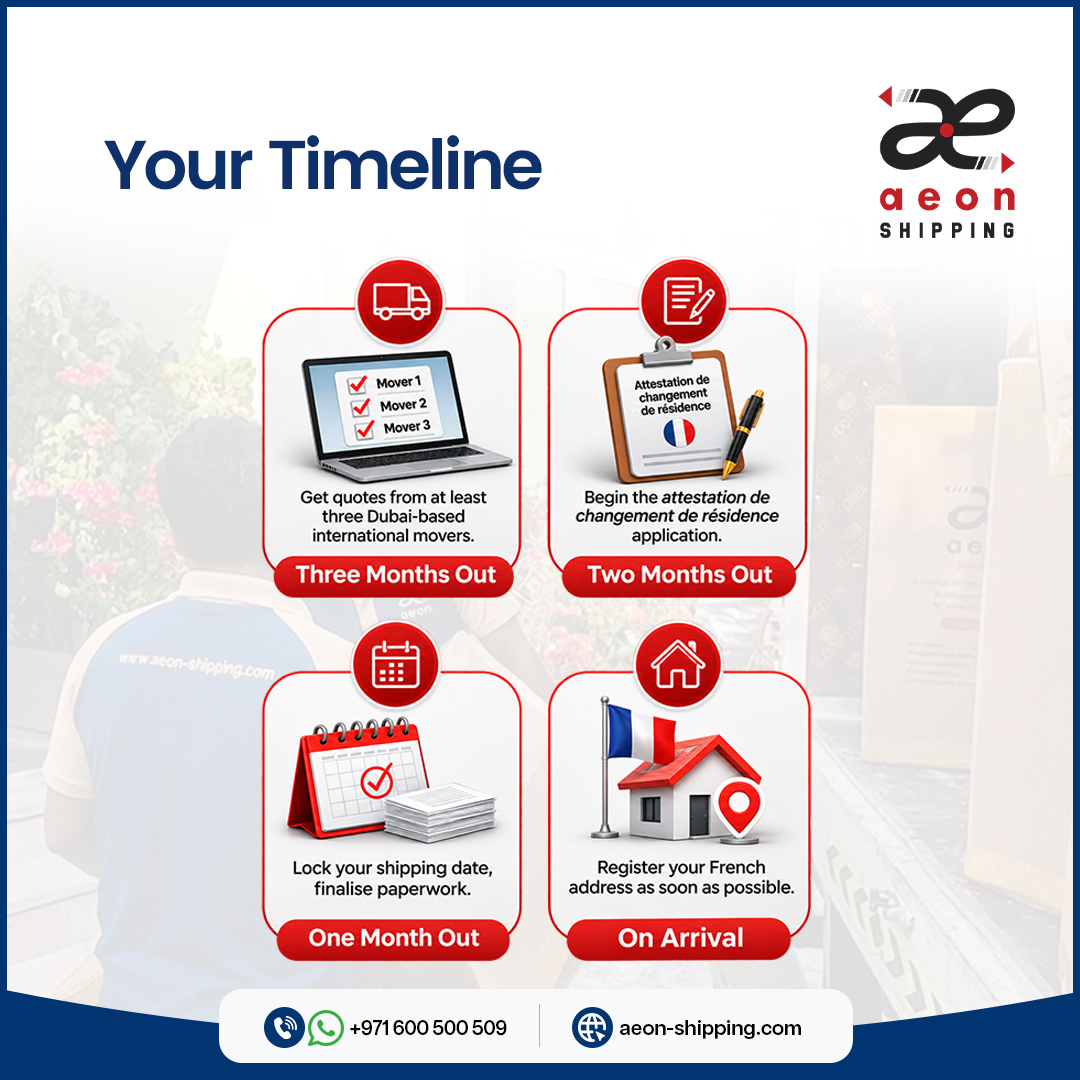
Two Months Out
Begin the attestation de changement de résidence application. Start your inventory list. This is also the time to begin clearing out anything you don’t actually need — every cubic metre costs money.
One Month Out
Lock your shipping date, finalise paperwork, set up utility disconnections in Dubai, and arrange temporary accommodation in France if your place won’t be ready immediately.
On Arrival
Register your French address as soon as possible. This documentation matters for customs. Stay reachable when your container is in transit — port processes sometimes move faster than expected, and an unreachable client means delays.
The Move Itself
Shipping household goods from Dubai to France is a long process. There’s no getting around that. The paperwork exists, the timelines are real, and the costs add up in ways that aren’t always obvious at the start.
But here’s the perspective worth keeping: people relocate from Dubai to France every month. They deal with the exact same forms, the same customs questions, the same container logistics — and their furniture arrives, gets unpacked, and eventually just becomes the furniture in their French home.
Six months from now, you won’t remember what the attestation de changement de résidence was called. You’ll be arguing cheerfully about the best boulangerie on your street, or sitting on your Marseille balcony watching boats, or navigating the Paris metro like you’ve lived there for years.
The container is just the part between now and that. Get a good moving company like Aeon-Shipping, start the paperwork early, and trust that the process — annoying as it is — works.

