
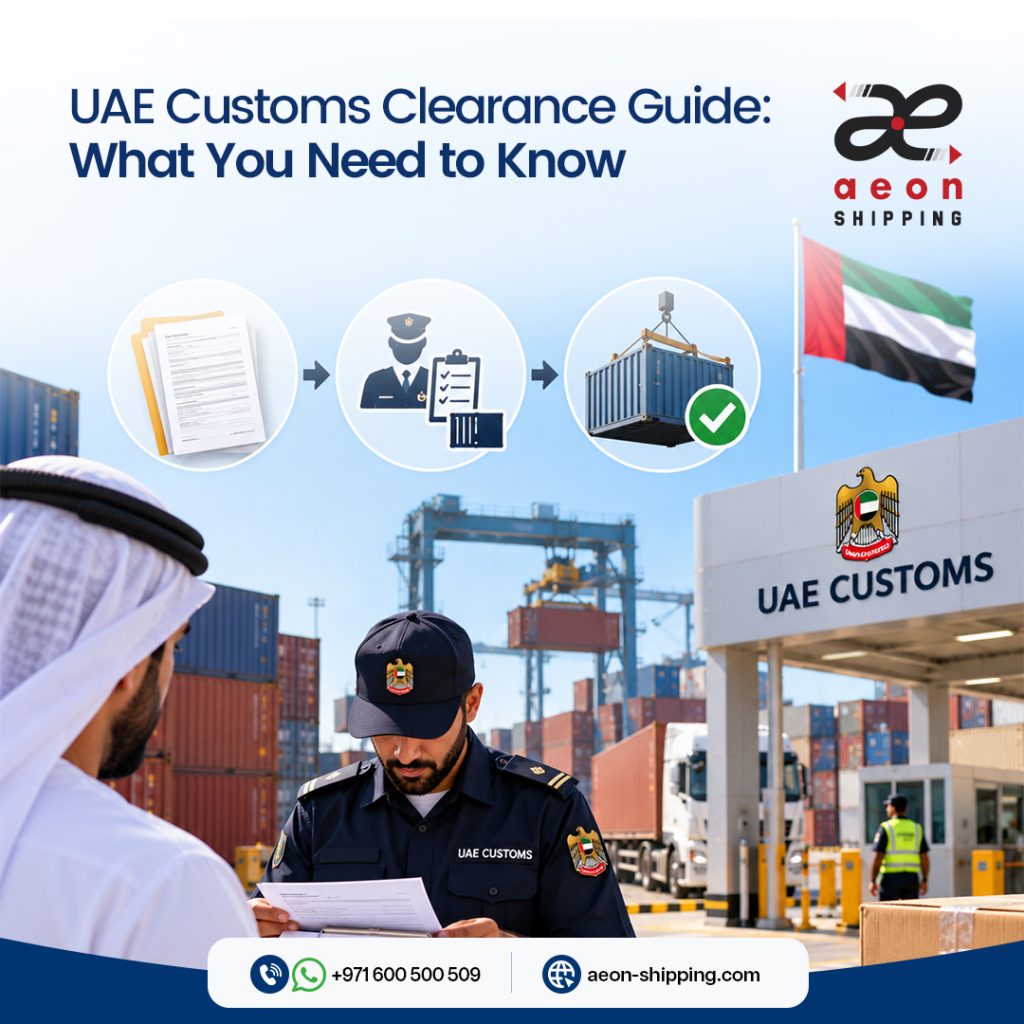
Bringing something into Dubai, or shipping it out? Then you need to understand Dubai customs clearance. This isn’t just a nice-to-know. It’s the thing standing between “my stuff arrived on time” and “my stuff is sitting at the port while I’m paying storage fees and hunting down a document I didn’t know I needed.” This guide covers what really happens step by step, what it costs, and where most people mess up the first time through.
Why Dubai Customs Clearance Matters More Than Most People Think
People underestimate this part. Honestly, it’s easy to see why. Dubai moves an insane amount of trade. Jebel Ali by itself ranks among the busiest ports anywhere. Then you’ve got the free zones layered on top. Those trips up a lot of newcomers. Every single shipment, in or out, has to go through Dubai Customs. And yes, the Dubai customs clearance process is thorough. That’s by design, not a flaw. A system that’s run properly gives you predictable results. As long as your paperwork’s sorted.
Here’s where people actually get burned, though: treating customs clearance like some last-minute box to tick. It’s not that. Get it wrong and you’re looking at delays. Storage fees piling up. Sometimes fines. All stuff you could’ve sidestepped with a bit of planning.
What Dubai Customs Clearance Actually Involves
At its core, clearing goods through Dubai Customs means submitting a customs declaration. This is the formal document that tells authorities what you’re bringing in, why, and what it’s worth. Depending on the movement, you’ll declare under one of five regimes: import, export, transit, transfer, or temporary admission.
Before you can even submit that first declaration, your business needs to be registered with Dubai Customs. You’ll need a valid Customs Business Code. This registration is a one-day process in most cases. It’s the gateway to everything else. Without it, you can’t legally transact with customs at all.
For most import shipments, you’ll need the following ready before your goods arrive:
- Commercial Invoice
- Packing List
- Bill of Lading (for sea freight) or Air Waybill (for air freight)
- Certificate of Origin (required in some cases)
- Delivery Order (DO) from the carrier or your agent
- Import Code (Customs Code) registered with Dubai Customs
- HS Code for the goods being shipped
- Relevant permits or approvals, if the items fall under a regulated category — for example, SIRA, MOFA, or Food Control clearance, depending on what’s being imported
The Dubai Customs Clearance Process, Step by Step
Knowing which documents you need is only half the battle. The other half is understanding the order things happen in. That’s what tells you how long clearance is going to take, and where things tend to get stuck.
Step 1: Get your declaration and paperwork sorted
Once your shipment’s ready to move, that’s your cue. Submit the declaration along with the commercial invoice, packing list, bill of lading or air waybill, and any permits that apply– all through Dubai Customs’ online system. Don’t rush this bit. Whatever happens later is built on what you get right here.
Step 2: Duty and Fee Assessment
Once your documentation is reviewed, Dubai Customs calculates the applicable duty. This is based on the declared CIF value, plus any service fees tied to your declaration type. Payment can typically be made online.
Step 3: Inspection, If Required
Not every shipment gets physically inspected. But customs can examine any consignment to confirm it matches what was declared. This step can be quick for straightforward shipments. Or it can add several days if anything looks inconsistent.
Step 4: Release and Clearance
Once everything checks out — documentation, duty payment, and inspection where applicable — customs issues clearance. The shipment gets released from the port or airport.
Step 5: Last-Mile Delivery
With clearance granted, the goods move to their final stop — a warehouse, a business address, or a private home. Coordinate this handoff with your freight forwarder ahead of time. It helps avoid delays once the goods are actually released.
For most straightforward shipments with clean documentation, this whole sequence moves quickly. Where things slow down almost always ties back to the same issues covered later in this guide: vague item descriptions, missing permits, or documentation gaps that trigger a closer look.
Understanding Dubai Import Tax
One of the most common questions people have before shipping anything into the Emirate: what will they actually owe? Dubai import tax — more accurately called customs duty — sits at a standard rate of 5% of the CIF value (Cost, Insurance, and Freight combined) for most goods.
There are notable exceptions. Alcohol carries a duty rate of 50%. Cigarettes, tobacco, and manufactured tobacco substitutes get taxed at a steep 100%. If you’re shipping any of these categories, budget accordingly. The standard 5% simply doesn’t apply.
For passengers rather than commercial shipments, there’s a separate allowance system. Gifts under AED 3,000 in value are generally clear without duty. There are also specific limits on tobacco and alcohol you can carry personally before duty kicks in. Anything beyond those thresholds gets taxed at the standard rates.
It’s also worth knowing that customs valuation isn’t arbitrary. Authorities mainly rely on the transaction value method — essentially, the actual price paid for the goods. A few fallback methods exist if that figure is in question. If customs officers doubt a declared value, they can request further documentation before accepting it. Accurate invoicing from the start saves a lot of back-and-forth later.
Customs Clearance Services — What They Cover and Why They Help
For businesses handling regular shipments, or individuals moving internationally, working with proper customs clearance services tends to be the difference between a smooth process and a stressful one. These services cover far more than just filing the declaration.
A good customs clearance provider handles the entire documentation chain – the invoice, the packing list, and the certificate of origin. And any permits from restricting authorities, which can range from the Ministry of Climate Change and Environment for animal products to Dubai Municipality for prepared foodstuffs, depending on what you’re shipping. They also manage cargo inspections when required. They handle discrepancies that come up in submitted cargo information. And they deal with amendments if something needs correcting later.
Beyond the paperwork, these services often maintain established relationships with the various customs centers across Dubai such as Jebel Ali, Port Rashid, the airport free zone, and Cargo village. That genuinely speeds things up when questions arise. Someone who’s cleared thousands of shipments through a specific port knows the common sticking points before they become your problem.
Fees for individual declaration services are relatively modest. Import and export declarations typically run between AED 15 and AED 100, depending on the shipping channel, with an extra AED 20 Knowledge and Innovation fee applied to any service costing AED 50 or more. Customs clearance services usually bundle these government fees with their own handling charges. So it’s worth asking for an itemised breakdown before committing to any provider.
Choosing the Right Customs Clearance Agents in Dubai
Not every shipment needs a dedicated agent. But for anyone unfamiliar with the process — or handling anything even slightly complicated — working with experienced customs clearance agents in Dubai removes a lot of the guesswork.
Who’s actually allowed to clear cargo on your behalf? Under Dubai Customs regulations, any company holding a valid Customs Business Code can submit declarations. Agents holding a Clearing and Forwarding license from the Dubai Economic Department can also clear cargo for consignees. They just need their own customs code and authorisation from the goods’ owner.
When selecting an agent, a few things are worth checking directly:
- Experience with your specific cargo type. Vehicles, restricted goods, and general household items all follow different documentation paths. An agent who’s handled your exact category before will move faster than one learning as they go.
- Transparency on fees. A reliable agent breaks down government charges separately from their own service fees. Not one lump figure that hides where the money’s actually going.
- Familiarity with restricted item categories. Certain goods — pharmaceuticals, printed media, telecommunications equipment, even certain lasers — need sign-off from specific regulatory bodies before customs will release them. A good agent knows which authority handles what. That saves you from discovering this the hard way, mid-shipment.
- Communication throughout the process. Customs can occasionally flag discrepancies or request clarification. An agent who catches this early and handles it fast is worth far more than one who only responds when you chase them.
Aeon Shipping checks each of these boxes directly. With more than 20,000 shipments completed and operations spanning over 135 countries, the team has handled the full range of cargo types — household goods, vehicles, restricted and regulated categories — through every major customs center in Dubai, including Jebel Ali and Port Rashid. Every quote is itemised upfront. Government fees and service charges are always shown separately. No surprises once your shipment is underway.
That combination of experience and transparency shows up in the numbers too: a 98% on-time delivery rate, a 99% customer satisfaction rate, and a 4.5-star Google rating built across more than 1,000 reviews. The only shipping company in Dubai to reach that milestone. For anyone weighing up customs clearance agents in Dubai, that track record is worth factoring in directly.
Common Mistakes That Delay Dubai Customs Clearance
A handful of issues account for most of the delays people run into:
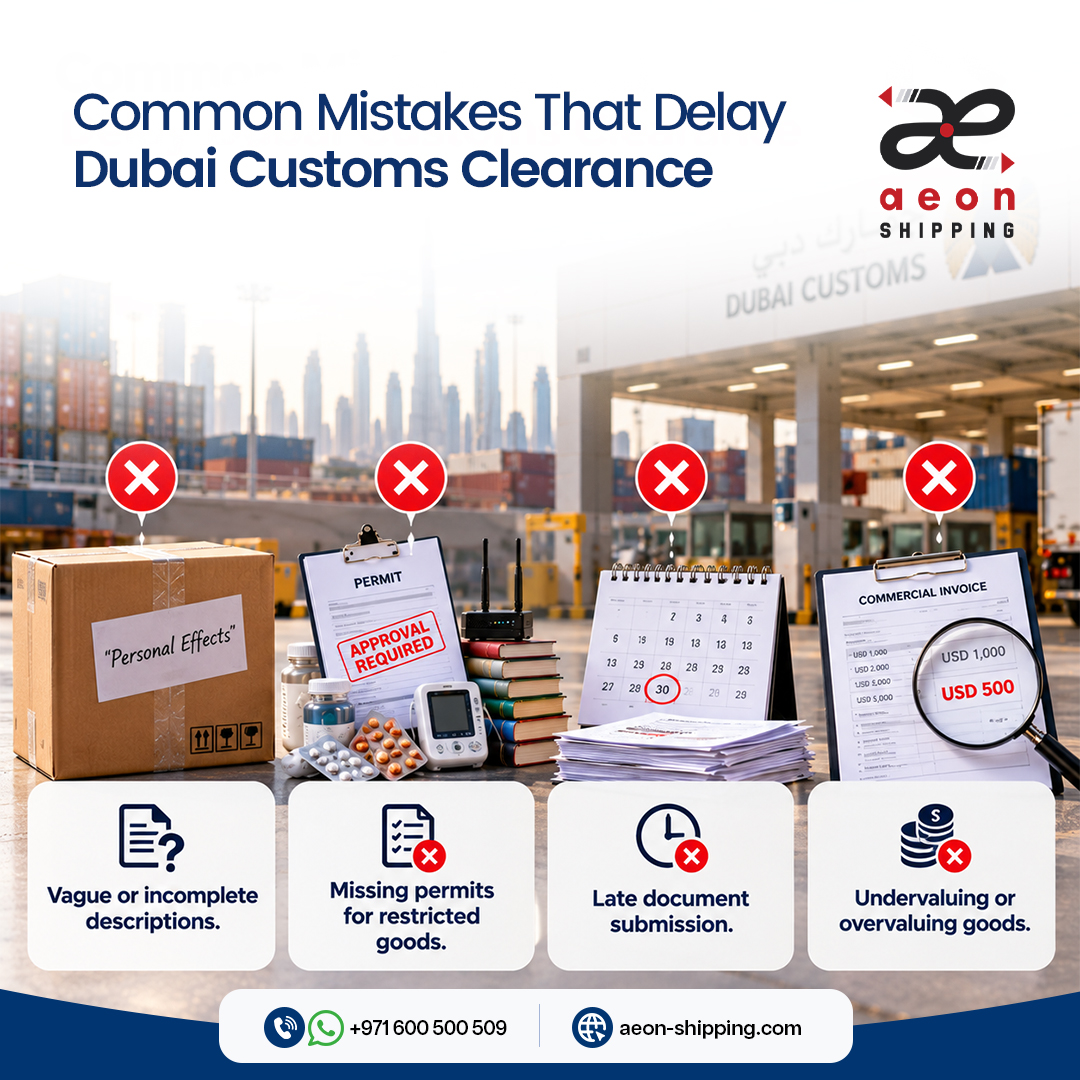
Vague or incomplete descriptions. Declaring a shipment as “personal effects” or “household goods” without specifics is a fast way to trigger a manual inspection. Detailed, itemised descriptions move through the system far more smoothly.
Missing permits for restricted goods. Certain categories — food products, medical devices, telecommunications equipment, even printed books and media — need approval from a specific regulatory authority before customs will clear them. Skip this step, and your shipment simply won’t be released. No matter how accurate the rest of your paperwork is.
Late document submission. Once a declaration is processed, supporting documents need to be submitted within 30 days. Miss that window, and a late fee applies for every day past the deadline, up to a maximum period. After that, further administrative action, including fines, can follow.
Undervaluing or overvaluing goods. Customs officers can request further evidence if they doubt a declared value. Get this wrong, and it either delays your shipment or leaves you exposed if you ever need to file an insurance claim.
Frequently Asked Questions
How long does Dubai customs clearance take?
Honestly, it depends on how accurate your paperwork is. If everything’s in order, you could be looking at just a few hours. But if customs decide to physically inspect your shipment, or something in the documents doesn’t quite add up, it can easily stretch into a few days while that gets sorted out.
How much is customs duty in Dubai?
For most goods, it’s a flat 5% based on the CIF value — that’s the cost of the goods plus insurance and freight combined. A couple of exceptions worth knowing: alcohol gets hit with a much steeper 50% duty, and if you’re shipping cigarettes, tobacco, or tobacco substitutes, expect a full 100% on top.
Do I need a customs broker to clear goods in Dubai?
Not always. Any business with a valid Customs Business Code can submit its own declarations. That said, for anything beyond a simple, low-value shipment — restricted goods, vehicles, or unfamiliar cargo categories — working with an experienced agent significantly reduces the risk of delays.
What documents are required for customs clearance in Dubai?
At the very least, you’re going to need a commercial invoice, a packing list, either a bill of lading or air waybill depending on how it’s shipped, an import code, and the right HS code for whatever you’re bringing in. Beyond that, some categories need extra paperwork on top — think a certificate of origin, or approvals from bodies like SIRA, MOFA, or Food Control, depending on what you’re actually shipping.
What happens if my shipment gets flagged for inspection?
It’s not necessarily bad news. Dubai Customs sometimes inspects shipments just to confirm the goods match what was declared. That’s a pretty normal part of the process. It will slow things down, though, especially if your documentation doesn’t clearly back up what they’re looking at.
What happens if I miss the document submission deadline?
You’ve got 30 days from when the declaration is processed to get your supporting documents in. Miss that, and you’ll start racking up a late fee for every extra day it takes. Let it drag on too long, and you could be looking at further penalties on top of that.
Can I clear customs myself, or do I need to register a business first?
Businesses need to register with Dubai Customs and obtain a Customs Business Code before submitting any declarations. Individuals clearing personal effects go through a separate, simpler process that doesn’t require business registration.
Final Thoughts on Dubai Customs Clearance
Getting through Dubai customs clearance without unnecessary delays really comes down to preparation. Register your business properly. Keep your documentation specific and complete. Understand what duty you’re actually liable for. And for anything beyond a straightforward shipment, bring in an experienced agent who knows the system inside and out.
The process itself isn’t designed to be difficult. It’s designed to be thorough. Showing up with clean paperwork and accurate declarations, the clearance through Dubai Customs is usually a fast, predictable part of doing business in one of the world’s busiest trade hubs. Rather than the bottleneck it becomes for shipments that arrive unprepared.

